Patio Heater Size Calculator That Actually Helps
A cold patio usually is not a heater problem. It is a planning problem. People buy a unit that looks powerful on paper, set it near a seating area, and then wonder why one chair feels hot while everyone else is still reaching for a blanket. A good patio heater size calculator helps you avoid that mismatch before you buy.
|
Free Tool
Size your patio in 30 seconds
Answer five quick questions about your space and our BTU calculator tells you exactly how much heat you need — and which Bromic heater to match.
Open the BTU Calculator →
|
The goal is not just to pick the biggest heater you can afford. It is to match heat output, fuel type, mounting style, ceiling height, wind exposure, and layout to the way you actually use the space. That matters even more when you are buying premium outdoor equipment. The right heater should feel intentional, not like a last-minute fix.
What a patio heater size calculator should tell you
At minimum, a patio heater size calculator should estimate how much heat your space needs and how that heat should be distributed. In practical terms, that usually means square footage, approximate BTU needs for gas models, or wattage for electric models. But raw output is only part of the picture.
Outdoor heating works differently than indoor heating because you are not trying to warm sealed air. You are trying to create comfort in an open environment where wind, ceiling height, and exposure all change the result. That is why two patios with the same square footage can need very different heater setups.
If you are working with a covered patio, the calculator should account for the fact that heat will collect and perform more efficiently than it would in a fully open yard. If your patio is exposed on all sides, you may need more total output or several heaters placed strategically instead of one oversized unit in the corner.
Start with the space, not the heater
The most useful way to size a patio heater is to map the area people actually occupy. A 20-by-20 patio is 400 square feet, but if your dining table and lounge seating only use 180 square feet of that footprint, the comfort zone is smaller than the patio itself. Heating the whole slab is usually inefficient and unnecessary.
Measure the active zone first. That includes dining tables, conversation sets, bar seating, and traffic paths people use while gathering. Once you know that number, you can think in terms of coverage instead of just output.
For a rough rule of thumb, many gas patio heaters are best suited to a defined radius rather than a full open rectangle. A freestanding mushroom heater may advertise a broad diameter of heat, but real-world performance depends on weather and placement. In calm conditions, that may be enough for a small seating group. In windy conditions, coverage shrinks fast.
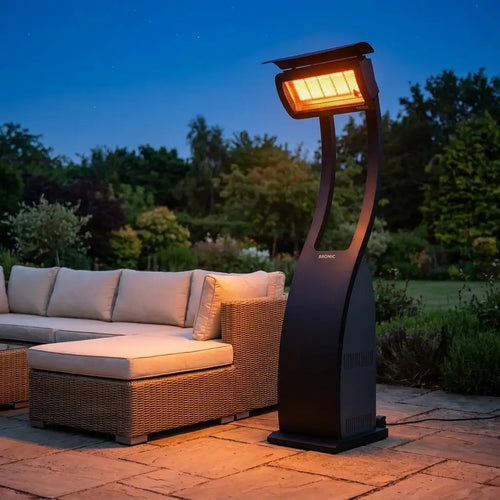
Electric heaters behave differently. They deliver directional radiant heat, which can feel more targeted and efficient in covered or semi-enclosed patios. If your seating arrangement is fixed and your mounting options are good, an electric setup can outperform a larger gas heater simply because the heat lands where people sit.
BTUs, watts, and what they actually mean
Shoppers often focus on BTUs because it is the most visible number in the category. More BTUs can mean more heat, but not always more comfort. A poorly placed 48,000 BTU freestanding heater can be less effective than two smaller units placed where people gather.
For gas patio heaters, calculators often estimate needs by square footage and exposure level. A small covered patio might need modest output if it has low wind exposure and close seating. A large open patio in a breezy area might require multiple high-output heaters or a different style entirely.
For electric heaters, wattage matters, but so does mounting height and angle. If the heater is installed too high, people feel less warmth at seated level. If it is too close, the heat can feel harsh or uneven. This is where a simple online calculator can only take you so far. It can point you toward a range, but installation details shape the final result.
A practical breakdown looks like this: use BTUs or watts to estimate total output, then use layout to decide how to divide that output. One heater covering everything sounds simpler, but in many patios, zone heating is the better answer.
Why coverage claims can be misleading
Manufacturers usually provide coverage estimates, but those numbers are often based on favorable conditions. They can be helpful for comparison, but they are not guarantees. Wind, ceiling height, ambient temperature, and furniture arrangement all affect performance.
That matters when you are comparing premium products. A better-built heater may have similar published output to a cheaper model, but stronger materials, more reliable burners, cleaner reflector design, or better mounting flexibility can change the experience over time. Sizing is not only about whether a heater turns on and produces heat. It is about whether it creates usable comfort through an actual season.
This is one reason calculators work best as a starting point, not a final answer. They narrow the field. They do not replace judgment.
Covered patio, open patio, or pergola - the setup changes the math
A covered patio usually needs less output than a fully exposed one because overhead structure helps retain warmth and reduce heat loss. That does not mean any heater will work. It means your heater type and placement can be more precise.
With a pergola, the answer depends on how open the roof and sides are. A tight pergola with curtains or privacy walls may behave closer to a semi-enclosed room. A slatted pergola in a windy yard may perform much more like an open patio. This is where many sizing mistakes happen. People classify every overhead structure as "covered" and undersize the system.
For open patios, trying to create complete warmth across a large footprint can get expensive and frustrating. In those spaces, it often makes more sense to heat specific activity zones. Focus on the dining table, the sectional, or the outdoor kitchen seating rather than the entire backyard.
One large heater or several smaller ones?
This is usually the most important decision a patio heater size calculator cannot fully make for you.
One large freestanding heater can work well for compact spaces with a central seating layout. It is easy to move, simple to operate, and often fits patios where flexibility matters. The trade-off is that heat tends to be strongest near the center and weaker at the edges.
Multiple heaters make more sense for larger entertaining areas, long dining tables, L-shaped patios, and spaces with separate zones. They create more even warmth and reduce the hot-spot problem. The trade-off is cost, more planning, and sometimes more visible hardware.
Mounted electric heaters are especially strong in this category. If you have a covered patio, defined seating areas, and access to the right electrical setup, they can look cleaner and perform more predictably than a freestanding gas unit. For homeowners building a cohesive outdoor space, that design advantage matters.
Common sizing mistakes
The first mistake is choosing by heater output alone. A high BTU rating looks reassuring, but if the heater style does not suit your layout, you may still feel cold.
The second is forgetting climate and wind. A patio in coastal Southern California needs a different approach than a backyard in Colorado or the Midwest. Same square footage, different heating reality.
The third is ignoring mounting height and clearance requirements. This shows up often with electric units. Even a well-sized heater can underperform if it is installed too high or too far from the seating zone.
The fourth is trying to heat dead space. Walkways, planters, and the far edge of a patio usually do not need dedicated warmth. Comfort is about where people linger.
How to use a patio heater size calculator well
Start with measurements of the occupied space, not just the full patio. Note whether the area is open, covered, or partially protected. Be honest about wind exposure. Then decide whether you want broad ambient warmth or focused heat on a few seating areas.
Once you have that, use the patio heater size calculator to estimate output range. From there, compare heater styles instead of jumping straight to the largest number. Ask whether the heater will be freestanding, wall-mounted, or ceiling-mounted. Think about fuel access, visual impact, and how permanent you want the setup to be.
This is also the stage where expert guidance is worth more than another hour of guesswork. Premium outdoor products are chosen by people who actually use this stuff, and heating is one category where that experience matters. A calculator can get you close. The right product match gets you the result.
The right size feels invisible
When a patio heater is sized well, nobody talks about it much. Guests stay outside longer. Dinner runs later. The space feels comfortable without anyone crowding around a single hot spot or dragging chairs into a tight circle.
That is really the point. A heater should support the way you live outdoors, not dictate it. If you use a patio heater size calculator as a planning tool instead of a shortcut, you will end up with a setup that feels balanced, looks intentional, and earns its place season after season.
Before you buy, picture the exact nights you want the space to handle - a family dinner, a football watch party, a quiet glass of wine on a chilly evening. Size for that experience, and the rest of the decision gets a lot clearer.
|
Ready to size yours?
Get your exact heater match
Skip the guesswork. Our calculator turns your patio's size, cover, wind, and climate into a specific heater recommendation in under a minute.
Open the BTU Calculator →
|