What Size Patio Heater Do You Need? (Watts & BTU Guide)
To size a patio heater, match its output to the area you want to warm and how exposed that area is. As a rough guide, a small seating zone or balcony is well served by a heater around 3,000W (electric) or roughly 11,000 to 20,000 BTU (gas), a typical patio by about 4,000 to 4,500W or 20,000 to 40,000 BTU, and a large or open space by 6,000W or more or 40,000+ BTU. Windy and uncovered spaces need more, and long areas are better covered by two units than one oversized heater. Here is how to get it right.
In this article
- Watts and BTU, explained simply
- Patio heater sizing chart
- What changes the size you need
- A smaller and a larger option
- Frequently asked questions

Watts and BTU, explained simply
Electric heaters are rated in watts (W) and gas heaters in BTU per hour. Both are just measures of heat output: more is hotter and covers more area. Because patio heaters warm people and surfaces directly with infrared rather than heating all the outdoor air, what matters is putting enough output over the seating zone, and mounting or placing it so the warmth lands where people actually sit. Use the numbers below as a starting point, then adjust for your conditions.
Patio heater sizing chart
| Space | Electric (approx.) | Gas (approx.) |
|---|---|---|
| Balcony or single seating zone | ~2,300 to 3,000W | ~11,000 to 20,000 BTU |
| Typical patio or covered porch | ~3,400 to 4,500W | ~20,000 to 40,000 BTU |
| Large or open patio | ~6,000W or more | ~40,000+ BTU |
| Long or L-shaped area | Two or more units | Two or more units |
These are starting points. Always check the manufacturer's stated coverage and clearances for the exact model.
What changes the size you need
Several things push you up a size. Exposure matters most: an open, uncovered, or windy spot loses heat fast and needs more output than a sheltered one. Mounting height affects coverage, since a heater placed too high spreads its warmth thin. Climate counts too, as colder regions and shoulder-season use call for more heat. And layout decides the count: one heater warms a compact circle well, but a long or wraparound seating area is far better served by two or more units spaced evenly than by a single oversized one.
A smaller and a larger option
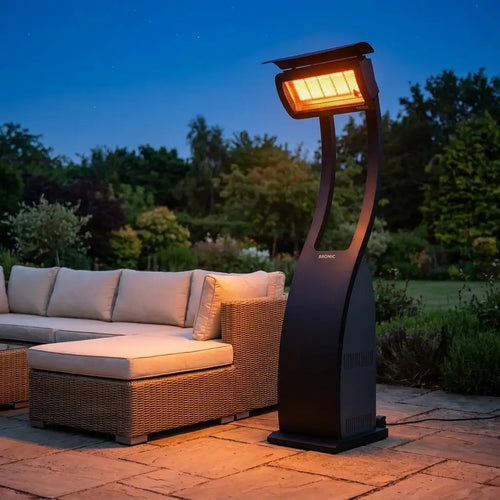
Two Bromic electric heaters at opposite ends of the range. Both link to their live product pages for the current price, and both ship free.

Right-sized output for a balcony, small porch, or a single seating zone.

High output and wide coverage for a large patio or a more exposed seating area.
Frequently asked questions
How much area does a patio heater cover?
It varies with output, mounting, and exposure, but as a rough guide a mid-size unit (around 4,000 to 4,500W or 20,000 to 40,000 BTU) comfortably warms a typical seating area, while smaller units suit a balcony and larger ones cover an open patio. Check the model's stated coverage.
How many BTU do I need for a patio heater?
For a single seating zone, roughly 11,000 to 20,000 BTU; for a typical patio, about 20,000 to 40,000 BTU; and for a large or open space, 40,000+ BTU. Increase for windy or uncovered areas.
Is one big heater or two smaller ones better?
For a compact area, one well-sized heater is fine. For a long, L-shaped, or wraparound seating area, two or more units spaced evenly give far more even warmth than a single oversized heater.
Does mounting height affect how well it heats?
Yes. Mounted too high, a heater spreads its warmth thin. Follow the manufacturer's recommended mounting height so the infrared lands on the seating zone.
Do I need more heat for an uncovered patio?
Yes. Open and windy spaces lose heat quickly, so size up, place heaters closer to where people sit, and consider more than one unit.
Find the right size patio heater
Premium Bromic heaters from compact to high-output, all with free shipping.
Shop patio heaters →More patio heater guides: best electric patio heaters, electric vs gas, the best patio heaters, mounted vs freestanding, and using one under a covered patio.