How Long Does a Propane Tank Last on a Fire Pit? (Burn Times by BTU)
Quick answer: A standard 20 lb propane tank holds about 430,000 BTUs of fuel. Divide that by your fire pit's BTU rating and you have your burn time. A typical 55,000 BTU fire pit table runs roughly 7 to 8 hours on high and about 15 hours at half flame. Smaller 40,000 BTU burners can stretch a single tank past 10 hours, while big 80,000+ BTU linear burners will drain it in 5 to 6.
Below you'll find the full burn-time table by BTU rating, the simple math behind it, what shortens burn time in the real world, and how to check how much propane you have left before guests arrive.
In this article
- How long will a 20 lb tank last at each BTU rating?
- How do you calculate burn time for any fire pit?
- What shortens burn time in the real world?
- How can you tell how much propane is left?
- How do you make a propane tank last longer?
- Which fire pit tables hide the tank inside?
- Frequently asked questions
How Long Will a 20 lb Tank Last at Each BTU Rating?
Every gas fire pit has a BTU rating: the amount of heat it produces per hour at full flame. A 20 lb tank (the standard exchange-size tank that fits inside most fire pit tables) holds about 4.6 gallons of propane, and each gallon contains roughly 91,500 BTUs. That gives you approximately 430,000 BTUs per full tank.
| Fire Pit BTU Rating | Burn Time on High | Burn Time at Half Flame |
| 40,000 BTU | ~10 to 11 hours | ~21 hours |
| 50,000 BTU | ~8 to 9 hours | ~17 hours |
| 55,000 BTU (most common on fire pit tables) | ~7.5 to 8 hours | ~15 hours |
| 60,000 BTU | ~7 hours | ~14 hours |
| 65,000 BTU | ~6.5 hours | ~13 hours |
| 80,000 BTU | ~5.5 hours | ~10.5 hours |
| 100,000 BTU | ~4.5 hours | ~8.5 hours |
Practical translation: for most fire pit tables, one tank comfortably covers three or four two-hour evenings on high, or a week of shorter sessions at a moderate flame.
How Do You Calculate Burn Time for Any Fire Pit?
If you know your fire pit's BTU rating, you can figure out burn time for any tank in ten seconds:
Burn time (hours) = 430,000 ÷ your fire pit's BTU rating
Example: the 55,000 BTU Crystal Fire® Plus burner found in many Outdoor GreatRoom fire tables. 430,000 ÷ 55,000 = about 7.8 hours at full flame.
Two things to keep in mind. First, BTU ratings are the maximum output, and almost nobody runs a fire pit wide open all night. At a typical "conversation flame" (around half throttle), double the numbers above. Second, exchange-program tanks are often filled to 15 to 17 lbs rather than a true 20, which trims 15 to 25% off these figures. If your burn times seem short, weigh the tank when you get it.

What Shortens Burn Time in the Real World?
Flame height is the big one: fuel use scales almost directly with how high you run the flame. Wind forces most people to turn the flame up to keep it visible, which burns more fuel (a wind guard solves this and pays for itself in propane). Cold weather matters more than people expect. As temperatures drop, tank pressure falls, and a tank that's nearly empty may struggle to feed a large burner at all. If your flame keeps shrinking on a cold night with a low tank, that's physics, not a defect. If the flame won't stay lit even with a full tank, see our guide on why your fire pit table won't stay lit.
How Can You Tell How Much Propane Is Left?
Three reliable methods, no gauge required:
- The warm water trick: pour a cup of warm water down the side of the tank, then run your hand down it. The metal turns cool at the propane fill line, because liquid propane absorbs the heat and empty space doesn't.
- Weigh it: most 20 lb tanks have a "TW" (tare weight) around 17 lbs stamped on the collar. Put the tank on a bathroom scale and subtract the tare weight. What's left is pounds of propane, and each pound is roughly 21,500 BTUs.
- Add an inline gauge: inexpensive pressure gauges screw between the tank and regulator and give an at-a-glance reading, though they get less accurate in cold weather.
How Do You Make a Propane Tank Last Longer?
Run the flame at the height the moment calls for, not maximum. Use a glass wind guard so a breezy night doesn't push you to full throttle. Keep a spare filled tank nearby (stored outdoors, upright, never indoors or in a garage) so a mid-party swap takes ninety seconds. And if you use your fire pit several nights a week, it's worth asking whether a natural gas connection makes sense, because a natural gas fire table never runs out mid-evening. Our guide on how to choose a propane fire table covers the tradeoff in detail.

Hides a spare 20 lb tank beside your seating area and doubles as a side table.

Which Fire Pit Tables Hide the Tank Inside?
Every fire table below stores a standard 20 lb tank inside the base: no tank sitting beside your seating area, no hose running across the patio.

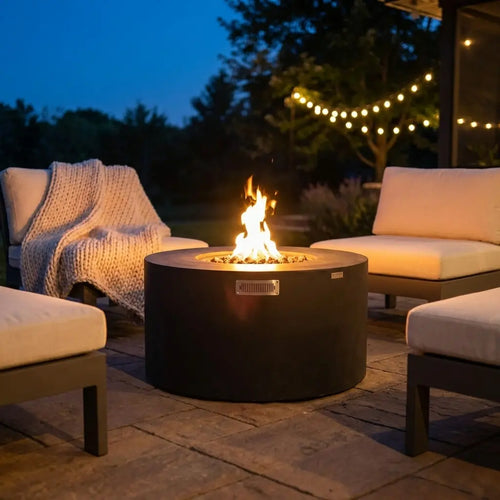
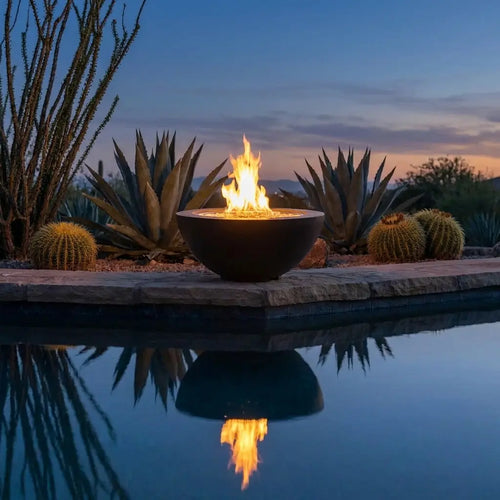
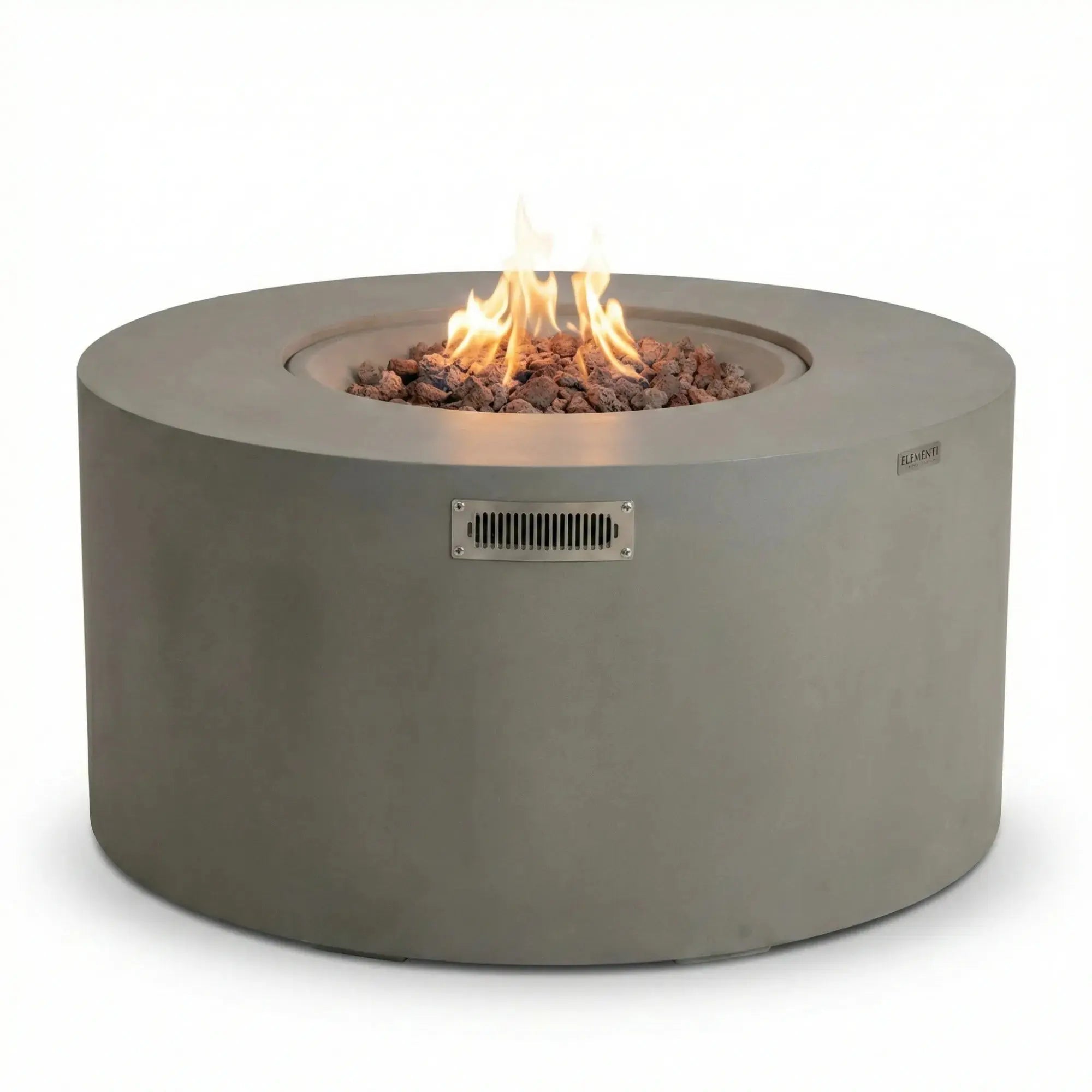
55,000 BTU Crystal Fire® Plus burner, about 7.5 to 8 hours per tank on high. UL listed, quick ship.

55,000 BTU burner in a composite wood-look table, about 7.5 to 8 hours per tank on high. Four finishes.

65,000 BTU linear burner (LP), about 6.5 hours per tank on high. Hidden access door for the 20 lb tank.
Want the full rundown of tank-in-base designs? See our guide to fire pit tables with hidden propane tanks.
Frequently Asked Questions
How long does a 20 lb propane tank last on a 50,000 BTU fire pit?
About 8 to 9 hours at full flame, or roughly 17 hours at half flame. A 20 lb tank holds about 430,000 BTUs; divide by the burner's output to get hours.
Can I use a 30 lb or 40 lb tank with my fire pit table?
Functionally yes, since the regulator connection is the same, but larger tanks won't fit inside the hidden-tank cabinet of most fire tables, so they'd sit outside the unit (a tank cover helps there). A 30 lb tank delivers about 645,000 BTUs and a 40 lb tank about 860,000, doubling your burn time. Always keep tanks upright and outdoors.
How much does it cost to run a propane fire pit per hour?
A 20 lb refill typically costs around $20 to $25. Spread over roughly 8 hours of full-flame burn on a 55,000 BTU table, that's about $2.50 to $3.00 per hour on high, and about half that at a moderate flame.
Why does my flame get weak before the tank is empty?
Cold weather and low fuel both reduce tank pressure, and a fast-burning fire pit can outpace a chilled tank's ability to vaporize propane. You may even see frost on the tank. Swap in a fuller tank or lower the flame. If the flame dies entirely on a full tank, the thermocouple or ignition system is the more likely culprit; see why your fire pit table won't stay lit.
Does a natural gas fire pit ever run out?
No. Natural gas runs off your home's gas line, so there's no tank to empty. Most fire tables we carry ship as propane with a natural gas conversion kit included. If you burn several nights a week, conversion is worth considering; start with The Complete Gas Fire Pit Buying Guide.
Never haul a tank across the patio again
Every hidden-tank fire table above runs a full evening on a single 20 lb tank, and the tank stays out of sight inside the base.
Shop all fire pit tables →Quick Ship models in stock, UL listed, natural gas conversion kits included.